2013 NASA Aerospace Safety Advisory Panel (ASAP) Annual Report, Issued January 2014 - International Space Station, Commercial Crew Risk and Budget, SpaceX, Exploration Program by unknow
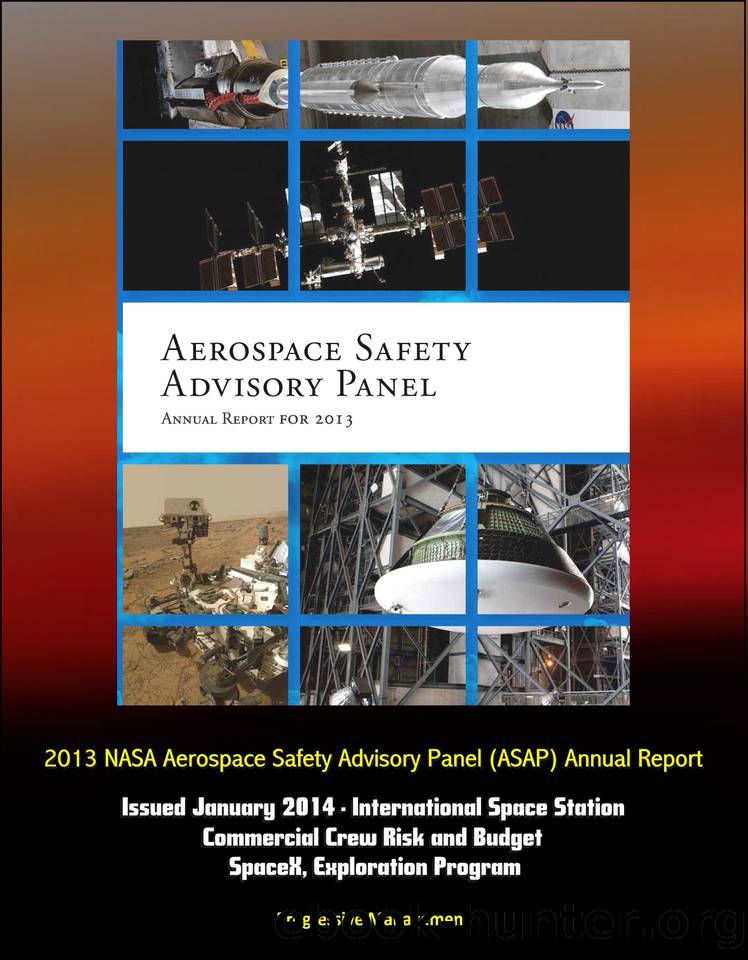
Author:unknow
Language: eng
Format: epub
Publisher: Progressive Management
Published: 2014-01-14T16:00:00+00:00
Aerospace Safety Advisory Panel
Vice Admiral Joseph W Dyer, USN (Ret.), Chair
Dr. James P. Bagian
John C. Frost
Deborah L. Grubbe, P.E.
John C. Marshall
Joyce A. McDevitt, P.E.
Dr. Donald P. McErlean
Dr. George C. Nield
Aerospace Safety Advisory Panel
Annual Report for 2011
NASA AEROSPACE SAFETY ADVISORY PANEL
National Aeronautics and Space Administration Washington, DC 20546
VADM Joseph W. Dyer, USN (Ret.), Chair
January 25, 2012
The Honorable Charles F. Bolden, Jr.
Administrator
National Aeronautics and Space Administration
Washington, DC 20546
Dear Mr. Bolden:
Pursuant to Section 106(b) of the National Aeronautics and Space Administration Authorization Act of 2005 (P.L. 109-155), the Aerospace Safety Advisory Panel (ASAP) is pleased to submit the ASAP Annual Report for 2011 to the U.S. Congress and to the Administrator of the National Aeronautics and Space Administration (NASA).
This report is based on the Panel's 2011 fact-finding and quarterly public meetings; "insight" visits and meetings; direct observations of NASA operations and decision-making; discussions with NASA management, employees, and contractors; and the Panel members' past experiences.
In our report we highlight issues on cost, schedule, resources, requirements and acquisition strategy that impact safety. Further, we again note the uncertainty regarding goals and objectives and the need for clarity and constancy of purpose. Importantly, we also acknowledge several of NASA's many accomplishments during calendar year 2011. We observe that transparency, the evolution of a safe and open culture, and key process advances have all significantly improved under your leadership.
A key and honest question that we pose is: "How safe is safe enough?" The pursuit of great reward often comes hand in hand with great risk—so it has always been with explorers. The answer to the question must come from a balance between risk and reward and should reflect a consensus among the American people, the White House, the Congress, and NASA. It is not our intent or purpose to answer the question; however, we point to areas where we believe the stated requirement may not produce the requisite safety. We especially invite your attention to the section "Reassessment of Space Shuttle Risks" and the historical gap between anticipated and deployed systems risk.
In this report, we have assumed that the purpose of the commercial crew initiative is to facilitate the near-term development of a U.S. commercial space transportation capability to achieve safe, reliable, and cost-effective access to and from low-Earth orbit (LEO). However, some among the stakeholders believe human transport to LEO is not the primary intent of the commercial crew initiative. They believe the intent is, instead, to foster a domestic U.S. space industry over a longer time horizon. We note that attention to and investment in safety are critical in developing near-term transport to LEO but may not be as significant in seeding a future industry. Some of the funding decisions and the resultant shifts in acquisition strategy give credence to those who believe the objective has indeed changed. We believe clarity is needed, and constancy of purpose must follow in either regard. We strongly believe those setting national strategy, providing resources, and planning for execution must all share in acknowledging and shouldering the risk.
Download
This site does not store any files on its server. We only index and link to content provided by other sites. Please contact the content providers to delete copyright contents if any and email us, we'll remove relevant links or contents immediately.
Personalized inhaled bacteriophage therapy for treatment of multidrug-resistant Pseudomonas aeruginosa in cystic fibrosis by unknow(157790)
Whisky: Malt Whiskies of Scotland (Collins Little Books) by dominic roskrow(74281)
CONSORT 2025 statement: updated guideline for reporting randomized trials by unknow(66082)
Critical evaluation of the ProfiLER-02 study design and outcomes by Vivek Subbiah & Razelle Kurzrock(65834)
Cardiac gene therapy makes a comeback by Oliver J. Müller & Susanne Hille & Anca Kliesow Remes(65272)
Unveiling the design rules for tunable emission in graphene quantum dots: A high-throughput TDDFT and machine learning perspective by Şener Özönder & Mustafa Coşkun Özdemir & Caner Ünlü(50860)
A yeast-based oral therapeutic delivers immune checkpoint inhibitors to reduce intestinal tumor burden by unknow(40226)
Covalent hitchhikers guide proteins to the nucleus by Alexander F. Russell & Madeline F. Currie & Champak Chatterjee(40192)
Meet the Authors: Christopher R. Mansfield and Emily R. Derbyshire by Christopher R. Mansfield & Emily R. Derbyshire(40058)
What's Done in Darkness by Kayla Perrin(27109)
Topological analysis of non-conjugated ethylene oxide cored dendrimers decorated with tetraphenylethylene: Insights from degree-based descriptors using the polynomial approach by A Theertha Nair & D Antony Xavier & Annmaria Baby & S Akhila(26485)
Investigation of mechanical and self-healing properties of hydroxyl-terminated polybutadiene functionalized with 2-ureido-4-pyrimidinone by Mohsen Kazazi & Mehran Hayaty & Ali Mousaviazar(26435)
The Ultimate Python Exercise Book: 700 Practical Exercises for Beginners with Quiz Questions by Copy(21018)
De Souza H. Master the Age of Artificial Intelligences. The Basic Guide...2024 by Unknown(20780)
D:\Jan\FTP\HOL\Work\Alien Breed - Tower Assault CD32 Alien Breed II - The Horror Continues Manual 1.jpg by PDFCreator(20650)
The Fifty Shades Trilogy & Grey by E L James(19607)
Shot Through the Heart: DI Grace Fisher 2 by Isabelle Grey(19487)
Shot Through the Heart by Mercy Celeste(19349)
Python GUI Applications using PyQt5 : The hands-on guide to build apps with Python by Verdugo Leire(17494)
